


If you’re pregnant, you’ve probably been told to eat six dates a day to help prepare your body for labor. It sounds simple enough, until you’re several days in and eating dates feels like another thing on your pregnancy to-do list.
As a registered dietitian who’s currently pregnant, I wanted to know how much evidence actually supports this advice. Some studies suggest eating dates in late pregnancy may improve certain labor outcomes, but the research has limitations. And the six dates used in one frequently cited study were considerably smaller than the large Medjool dates you might be buying. Here’s what to know before committing to a daily date routine, plus the Halloween version I made with peanut butter, chocolate and caramel.
Can Eating Dates During Pregnancy Help With Labor?
Researchers have studied whether eating dates toward the end of pregnancy affects cervical dilation, the need for induction and how labor progresses. These are related outcomes, but evidence for one doesn’t automatically establish a benefit for the others.
The Original Six-Dates-a-Day Study Was Small
A 2011 study published in the Journal of Obstetrics and Gynaecology followed 114 women with low-risk pregnancies. Of those, 69 ate six dates daily during the four weeks before their estimated due date, while 45 ate none. The women who ate dates had greater cervical dilation when admitted to the hospital and were more likely to go into labor spontaneously. They also had less use of medications to induce or strengthen labor.
Those findings are encouraging, but the participants weren’t randomly assigned to their groups. That leaves room for differences between the women to help explain the results. The study shows an association; it cannot establish that eating dates caused those outcomes.
Later Research Has Found Some Benefits, With Limitations
In a 2017 randomized trial of 154 women having their first baby, those assigned to eat dates needed less oxytocin to strengthen labor. However, the researchers did not find a significant difference in spontaneous labor onset. That distinction gets lost in advice claiming dates will help you “go into labor.”
A 2024 systematic review examined 48 studies covering date consumption during pregnancy, labor and postpartum. The late-pregnancy analyses suggested benefits for some outcomes, including cervical dilation, the need for induction and Bishop score, an assessment that includes how ready the cervix is for labor.
However, most studies had a high risk of bias, and only four randomized trials were rated as having excellent methodological quality. The amount and type of dates varied, and safety reporting was limited. These findings give researchers a reason to keep studying dates. They don’t establish a reliable way to ripen your cervix or make delivery easier.
How Much Sugar Is in Six Dates?
The size of the dates makes a substantial difference.
In the 2011 study, six dates weighed approximately 60 to 67 grams total. Six large Medjool dates, using the USDA reference weight of 24 grams each, weigh about 144 grams. That’s more than twice as much fruit.
Here’s how those amounts compare:
| Amount of plain dates | Approximate total sugar | Approximate total carbohydrate |
|---|---|---|
| 60–67 grams, the amount used in the original study | 38–45 grams | 45–50 grams |
| Six large Medjool dates, about 144 grams | 96 grams | 108 grams |
These are estimates calculated from USDA reference values for Medjool and Deglet Noor dates. The study-portion estimate accounts for variation between those varieties; the researchers did not report a measured sugar content for their actual fruit. Toppings are not included.
So yes, six large Medjool dates contain a substantial amount of sugar. But saying the original study required participants to eat 96 grams of sugar from dates each day would overstate the amount.
Dates also provide fiber and potassium, and the naturally occurring sugar in plain dates doesn’t count as added sugar. A sugar total alone doesn’t make them a food you need to avoid. It does help explain why the portion needs more specificity than “eat six.”
What If You Have Gestational Diabetes?
If you have gestational diabetes, the total carbohydrate amount, portion size and your individual blood glucose response all need to inform how dates fit into your eating plan. The National Institute of Diabetes and Digestive and Kidney Diseases recommends working with your care team on food choices, amounts and timing to help keep blood glucose within your target range.
Naturally occurring sugar still contributes carbohydrate. Peanut butter adds fat and some protein, but it doesn’t cancel out the carbohydrates in the dates or toppings. As the NIDDK explains in its guidance on eating with diabetes, carbohydrate-containing foods can raise blood glucose, and portions may need to be adjusted to your individual needs.
The labor research also doesn’t establish that a daily date regimen is appropriate for people with gestational diabetes. The original study enrolled low-risk pregnancies, and the 2024 review excluded studies involving high-risk pregnancies or serious antenatal complications.
As a dietitian, I wouldn’t recommend adding a large daily portion solely for an uncertain labor benefit, especially if it makes managing your blood sugar harder. You may be able to enjoy dates in an amount that fits your plan, without committing to six every day.
Do You Need to Eat Dates to Prepare for Labor?
Based on the available evidence, I would not treat six dates a day as a pregnancy requirement. There are promising findings, but the research still calls for better-quality studies to establish how much they help and what amount, if any, to recommend.
If you enjoy dates, there’s no need to make eating them complicated. If you’re forcing them down because you’re worried you’ll miss your chance at an easier labor, I would take that pressure off. You already have enough to think about.
Spooky Halloween Dates With Peanut Butter and Chocolate
Watch my spooky Halloween dates recipe on Instagram
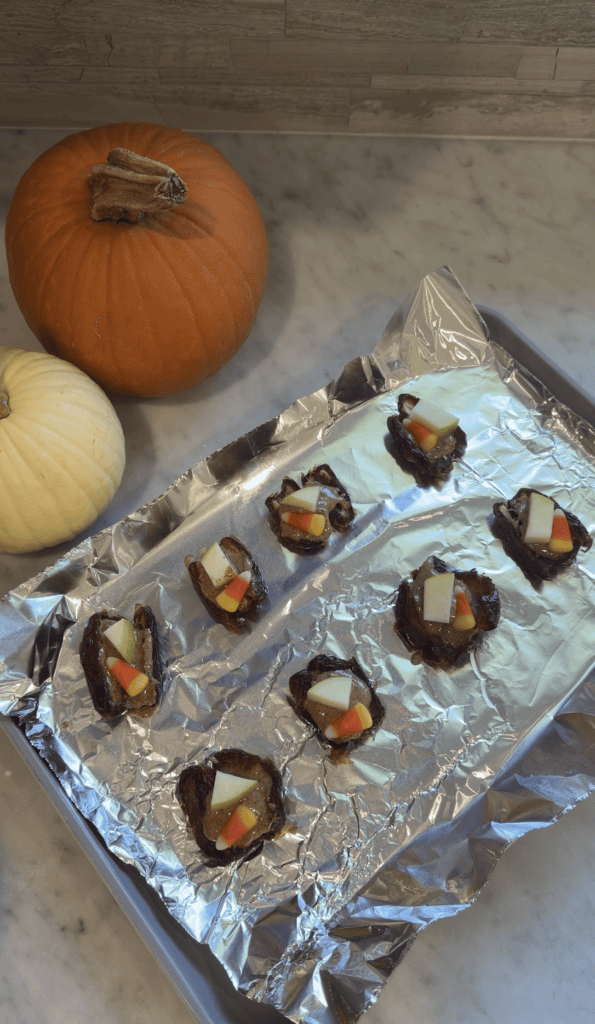
In my Instagram recipe video, I made these with the text “when you’re trying to eat six dates a day but it’s spooky season.” The research needs more context than fits over a recipe video, but the recipe itself is pretty straightforward: open and smush the dates, add peanut butter and drizzle away.
Yield: 12 topped dates
Prep time: About 15 minutes
Optional chill time: 10–15 minutes
Ingredients
- 12 soft dates, such as Medjool
- About ¼ cup peanut butter
- ¼ cup dark chocolate chips or chopped dark chocolate
- 2 tablespoons melted caramel or thick caramel sauce
- 12 tiny pieces of apple
- 12 pieces candy corn
Directions
- Open and smush the dates. Line a plate or small tray with parchment paper. Slice each date lengthwise and remove the pit. Open it flat and gently press it down with your fingers or the back of a spoon.
- Add the peanut butter. Put a small dollop, about 1 teaspoon, in the center of each date.
- Melt the chocolate. Place the chocolate in a dry, microwave-safe bowl. Microwave in 15-second intervals, stirring between each, until melted.
- Drizzle the toppings. Drizzle the melted chocolate over the dates, followed by the caramel. If using caramel candies, melt according to the package directions.
- Add the apple and candy corn. Press one tiny piece of washed apple and one candy corn onto each date while the toppings are still soft.
- Serve or chill. Enjoy immediately, or refrigerate for about 10–15 minutes to help the chocolate set.
For the best apple and candy texture, add those toppings close to serving. If you prepare the filled and drizzled dates ahead, keep them covered in the refrigerator.
This recipe makes 12 pieces. Choose the amount you want to eat; the batch size is not a daily recommendation.


